


The importance of your own four walls as a place of retreat gains significance in times of crisis. When we spend most of our time at home, a relaxing, atmospheric environment plays an important role. To bring a splendor of color, versatility and a touch of exoticism into our homes, the Asian interior design style is an ideal choice.
Bold colors and clear shapes characterize the Asian interior design style
The Asian continent is the largest on Earth. It extends in the north from the Arctic Ocean to the Indian Ocean in the south. In the east, it begins at the Pacific and reaches as far as the Urals in the west. Due to this size, numerous different cultures emerged in Asia. The Asian interior design style is primarily shaped by country-specific designs from:
- Japan,
- China,
- India,
- Nepal as well as
- the Southeast Asian countries.
Because of this diversity, you benefit from a choice among many colors. Delicate pastel shades come from Japan. Bold colors such as red or gold stand for China, the “Middle Kingdom.” Bright shades dominate on the Indian subcontinent. Certain color combinations characterize the Asian interior design style. In China, the color yellow plays an important role. It symbolizes neutrality and balance.
We associate Japan with white and cherry blossom pink. In the “Land of the Rising Sun,” people also appreciate the color combination of white, red and black. To bring a touch of Asia into your own home, choose corresponding colors for decoration and home textiles.
Furthermore, clear and straight-lined shapes stand for the interior design style from the Far East. Tables and seating are characterized by simple elegance. If you prefer a natural design in your home, solid wood furniture is recommended. Alternatively, you can get atmospheric furnishings in a bamboo look.
Which materials are suitable for the Asian style in the home?
The interior design style from the Far East stands for naturalness and simplicity. For this reason, materials from nature are recommended. Sandalwood or mango wood are suitable for furniture. Another recommendation is Chinese elm wood. Natural components also play an important role in decoration. In addition to green plants, beautiful stones give your home the finishing touch. They serve as eye-catchers and round off the interior.
Flowers such as orchids, lotus or cherry blossoms bring you the delicate exoticism of the Asian region. Vases or planters made of porcelain are suitable for the plants. The material originated in Asia. It is inseparably linked with the corresponding design. On armchairs and sofas, for example, place cozy cushions with silk covers.
Which symbols are relevant in the Asian interior design style?
Depictions of the gods are part of Asian interiors. Golden Buddha statues create a cozy flair in your home. Alternatively, choose busts of the Hindu goddess Shiva. The dragon is also a symbol for many Asian countries. It stands for power and wisdom. As a patron saint, it serves as a lucky charm. If you prefer more classic animal figures, choose elephants as a symbol of good luck.
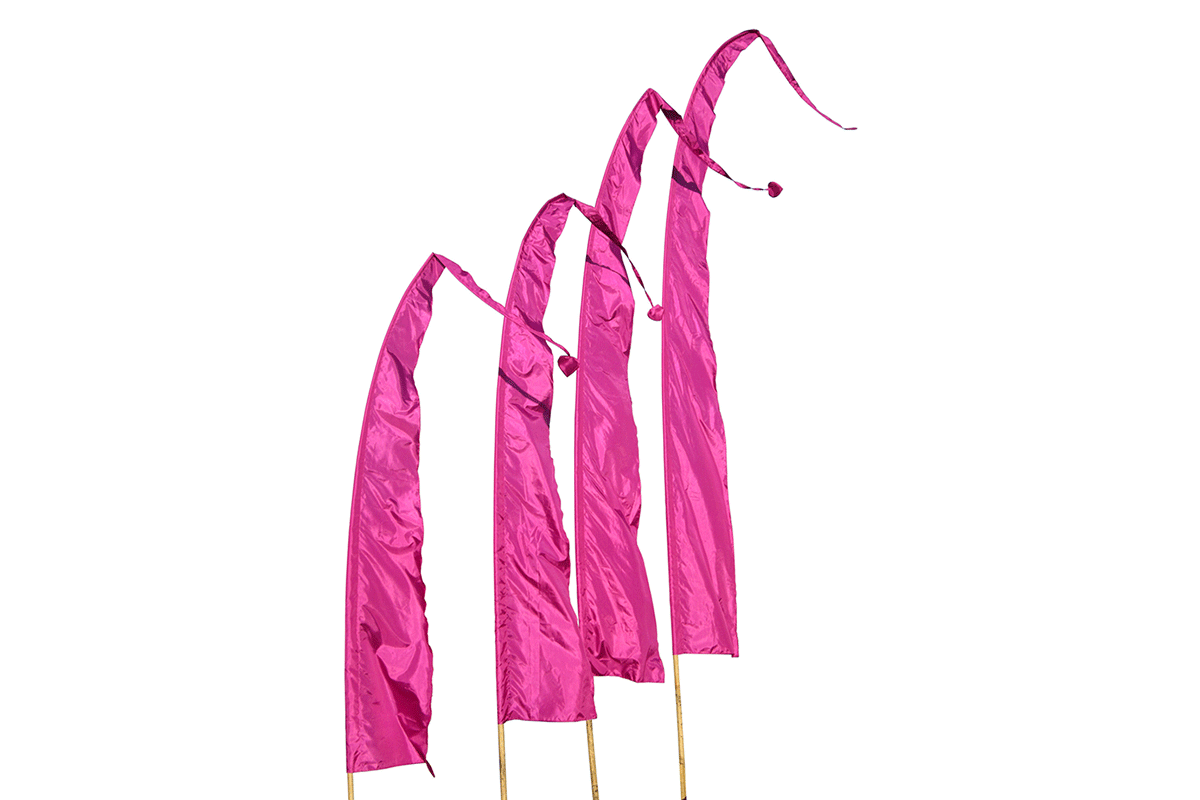
Bali flags bring strength and purity into our home
On the Indonesian island of Bali, the Bali flags – traditionally called Umbul-umbul – have a signaling function. In the past, they were part of the offerings at Balinese temples. Compared with Western flags, they are characterized by their narrow design. At the curved tip, mirrors or little bells serve as decorative elements. In Bali, the flags bear witness to the presence of the gods. Therefore, they can be found at festivities as well as at temples, streets and beaches.
As a decorative element, Bali flags are suitable in the Western cultural sphere for the home, balcony or garden.
Bali flags are traditionally monochrome, with each color having its own meaning. For example, red symbolizes courage. White, as in many cultures, stands for purity. Further color meanings can be seen in:
- Blue for fame,
- Green for peace,
- Yellow for eternity,
- Black for power.
If you use the Umbul-umbul – translated, this means “tail of the dragon” – base your color choice on the meaning and your home decor. To enjoy more Balinese design within your own four walls, combine the flags with driftwood decorations or pressed plants as wall decorations.


